
CRT has become popular because it is compact: one candle, one range, one question. That simplicity is useful — and it is also why CRT works best when it sits on top of a proper read of market structure.
What Candle Range Theory says
Pick a higher-timeframe candle — commonly a 4-hour or daily candle. Its high and low define a range. Resting orders tend to sit just beyond both ends of that range: stop-losses and breakout entries.
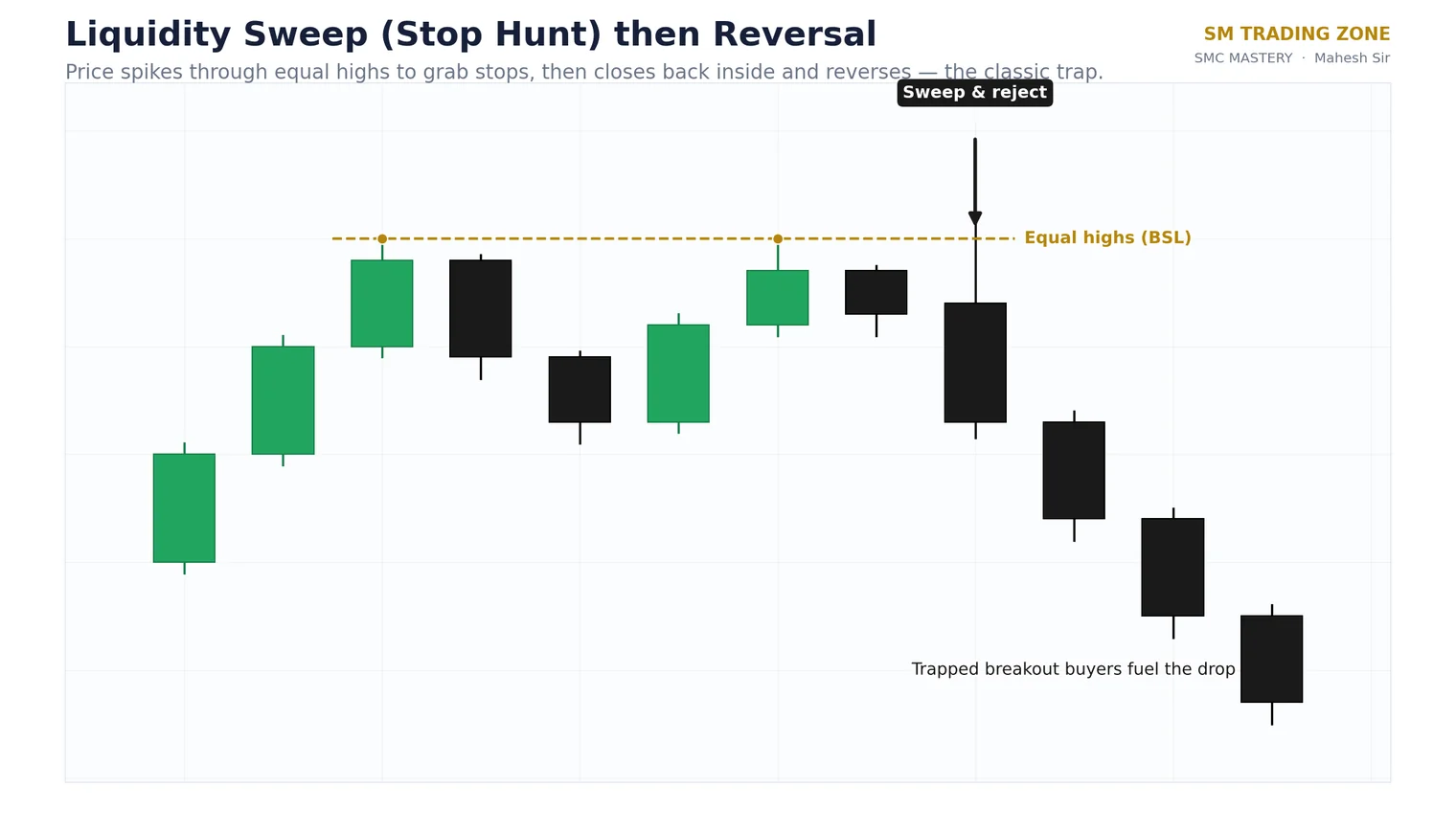
CRT watches the next candle (or candles). If price trades beyond one side of the range and then closes back inside it, the model reads that excursion as liquidity being taken rather than a genuine breakout, and looks for price to travel toward the other side of the range.
The three-candle model
- Range candle. The reference candle; its high and low are the range.
- Manipulation candle. Trades beyond one side of the range — the sweep — and closes back inside.
- Distribution. The move the model is looking for: back through the range toward the opposite extreme.
This maps neatly onto the accumulation–manipulation–distribution (AMD, or Power of Three) idea. Practitioners also pay attention to timing — which 4-hour candles of the day tend to deliver the sweep — and refine entries on a lower timeframe with a sweep, a market structure shift and a fair value gap retest.
How CRT differs from SMC
| Question | CRT | SMC |
|---|---|---|
| Unit of analysis | One higher-timeframe candle's range | The whole swing structure across timeframes |
| Core event | Sweep of the range + close back inside | BOS/CHoCH, inducement, sweeps into zones |
| Zones | Range high, range low, midpoint | Order blocks, FVGs, supply/demand, premium/discount |
| Timing | Strong — which candle of the day | Usually session-aware, less rule-based |
| Rules to learn | Few | Many |
| Main weakness | Ignores context if used alone | Can become subjective without strict rules |
Using them together
The most common mistake with CRT is taking every sweep-and-close. A range sweep that runs straight into a higher-timeframe supply zone, or against a clear structure trend, is a much weaker read than one that agrees with structure. SMC supplies that filter:
- Use SMC on the higher timeframe to decide bias (structure, premium/discount, where liquidity is resting).
- Use CRT to decide timing — which candle's sweep to act on.
- Use a lower-timeframe structure shift for the entry, with risk defined beyond the sweep.
No combination removes risk. Sweeps fail, ranges extend, and news can override any model — which is why position sizing and a written plan matter more than the model itself.
Key takeaways
- CRT reads one higher-timeframe candle as a range and looks for a sweep plus a close back inside.
- It is a compact model built on the same liquidity idea SMC uses.
- SMC gives context (bias, zones); CRT gives timing. Together they filter weak setups.
- Neither is a signal system; risk management decides outcomes.
Frequently asked questions
What is Candle Range Theory (CRT)?
CRT treats the high and low of one higher-timeframe candle (often 4-hour or daily) as a range. When a following candle trades beyond one side of that range and then closes back inside it, the model looks for price to travel toward the opposite side of the range. Entries are usually refined on a lower timeframe.
Is CRT part of SMC?
CRT is a compact model built on a liquidity idea that SMC also uses: highs and lows hold resting orders that are often taken before a move. SMC reads the whole market structure; CRT focuses on one candle's range. Many traders use SMC for context and CRT for timing.
Which is easier for beginners, CRT or SMC?
CRT has fewer moving parts, so its rules are quicker to learn. But it is easier to apply well when you can already read structure and liquidity, which is what SMC teaches. Learning SMC structure first makes CRT setups much easier to filter.
Where can I learn CRT for free?
SM Trading Zone published a free CRT lecture playlist on YouTube from its June 2026 batch, linked from the CRT course page. The live Complete Syllabus covers CRT in more depth alongside SMC, ICT and the 2 CR method.